Workplace wellness is changing.
For years, the term was largely associated with fitness challenges, annual health fairs, gym memberships, biometric screenings and employee assistance programs. Many of those benefits still have a place. But the workplace itself has changed, and employee wellness is changing with it.
Hybrid schedules have altered where and how people work. Technology and AI are accelerating the pace of business. Employees are navigating longer periods of screen time, information overload and increasingly blurred boundaries between work and life.
At the same time, expectations around the workplace experience have evolved.
The question is no longer simply, “What wellness programs do we offer?”
A more useful question may be:
How well does our workplace support wellbeing during the actual workday?
From Wellness Programs to the Workplace Experience
Traditional workplace wellness has often existed alongside the workday rather than within it. And too often, employees need to be incentivized—or even coaxed—to participate.
Employees receive access to a wellness portal. A webinar is scheduled. A fitness challenge launches. A meditation app becomes part of the benefits package.
These resources can be valuable, but they often require employees to take an additional step: remember the benefit exists, find the time, log into another platform, attend at a particular hour or engage after work.
That creates friction.
And participation remains a real challenge. Recent employer research continues to identify low participation as one of the most common obstacles facing workplace wellness programs.
The next evolution of workplace wellness is beginning to look different.
Rather than asking employees to continually go somewhere else for wellness, organizations are beginning to consider how wellbeing can be incorporated into the environments and routines employees already encounter.
That can include spaces designed for movement or recovery, healthier snacks and hydration, everyday nonprescription wellness support, quiet spaces, brief educational experiences and resources employees can access when they actually need them.
Wellness becomes less of an occasional initiative and more of an accessible part of the workplace experience.
The Small Moments Matter
Not every wellness need requires a program.
Sometimes an employee realizes halfway through the afternoon that they have barely moved from their desk.
Someone arrives after a difficult commute and needs a few minutes to reset before the first meeting.
Another employee finishes a workout before work and realizes they forgot a personal-care product or needs an ice pack for a pulled muscle.
Someone else feels the beginning of a headache, needs an everyday wellness product or simply wants a better option than what is traditionally available in the break room.
Individually, these moments seem small.
Collectively, they represent something important: much of wellbeing is shaped by ordinary decisions made throughout the day.
Workplace wellness solutions that recognize these moments can create a different kind of employee experience.
Instead of wellness existing primarily as programming, it becomes something employees can encounter and use naturally.
Convenience Is Becoming Part of Wellness
Convenience has transformed nearly every part of modern life.
People can order groceries from their phones, access financial information instantly, work from multiple locations and receive personalized recommendations within seconds.
Yet many workplace wellness programs still depend on employees seeking out resources somewhere else.
That disconnect matters.
Access does not guarantee engagement, but unnecessary friction can certainly reduce it. Research into workplace wellness participation has identified convenience as an important factor in whether employees actually engage with available wellness resources.
This is why on-site wellness amenities are becoming an important part of the broader workplace wellness conversation.
The goal is not to replace comprehensive employee benefits, healthcare resources or wellness programming. It is to complement them by addressing a different part of the employee experience: everyday access.
A thoughtfully designed workplace can make healthier choices easier to encounter.
Wellness Requires More Than Putting Products in a Room
There is an important distinction between providing wellness products and creating a credible wellness amenity.
Wellness done well requires expertise.
What belongs in the environment? Which companies are reputable? Which products are third-party tested? What will employees realistically use? Which products are appropriate for broad workplace access? What guardrails are needed? And how should the experience be organized, maintained and replenished?
A technology company, medical office, corporate headquarters and professional office building may have very different populations and workplace cultures.
Effective wellness amenities should reflect that context.
Curation matters.
So does operational execution.
An amenity that is poorly stocked, confusing or filled with products that have little relevance to the people using it quickly loses value.
The strongest workplace wellness solutions create alignment between the environment, the people using it and the resources being offered.
Technology Can Make Wellness More Responsive
Technology is also changing what workplace amenities can become.
Smart inventory systems can help operators understand what employees actually use rather than relying entirely on assumptions. Digital education can provide additional context around available wellness resources. Automation can improve replenishment and operational consistency.
AI may make these environments even more responsive, helping employees navigate available resources and discover options relevant to what they are looking for.
But technology should remain an enabler rather than the experience itself.
The objective is not to make wellness more complicated.
It is to make access simpler.
As workplaces become increasingly technology-driven, there may actually be greater value in creating physical environments that support the human experience of the workday.
The Workplace Is Competing for Relevance
Hybrid work introduced another important consideration.
For many employees, coming into the workplace is now a choice made more consciously than it once was.
That means employers and building operators are thinking differently about what the workplace provides that cannot easily be replicated at home.
Amenities are part of that equation.
Employees may not commute simply because an office has wellness amenities. But the cumulative workplace experience matters.
Convenient services, thoughtful spaces, opportunities for connection and accessible wellness resources can all contribute to an environment that feels intentionally designed around the people using it.
That creates value beyond any single amenity.
It signals that someone has considered what the workday actually feels like.
A More Integrated Model of Workplace Wellness
This is where the definition of workplace wellness begins to expand.
The future is unlikely to be one program, platform or benefit.
It will be an ecosystem.
Traditional benefits will remain important. So will education, leadership, movement, nutrition, recovery and preventive healthcare.
But physical wellness infrastructure can become another layer of that ecosystem. This broader movement from siloed programs toward more integrated workplace wellness strategies is already taking shape.
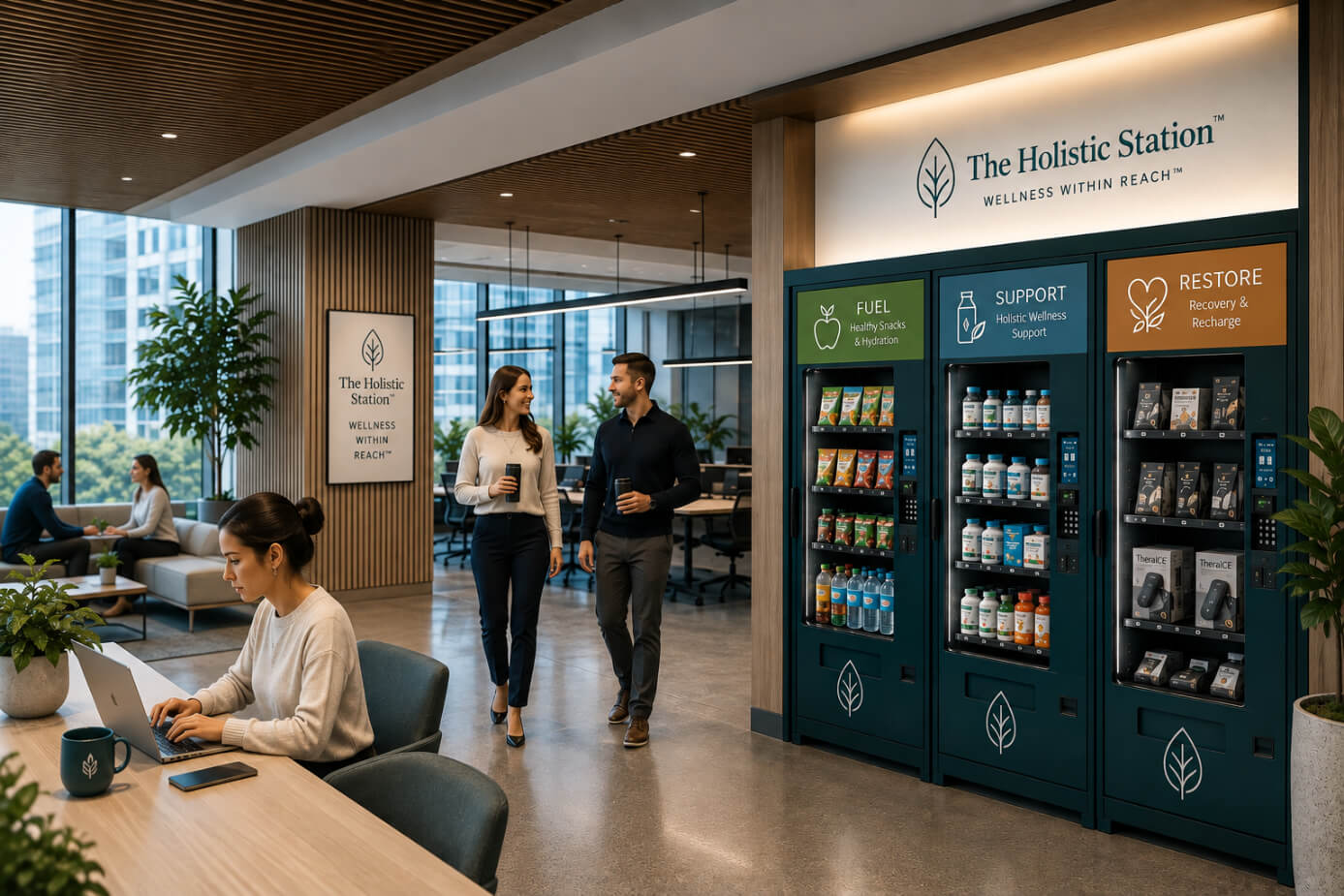
The Holistic Station™ was designed around this emerging model: a managed wellness amenity that brings curated wellness access directly into the places people live, work, stay and gather.
Within workplace environments, that can mean access to FUEL for healthier snacks and hydration, SUPPORT for everyday nonprescription wellness support, and RESTORE for recovery-focused products.
The distinction is important.
The objective is not simply to install vending machines.
It is to thoughtfully manage a wellness resource within the workplace, with appropriate curation, guardrails and ongoing operational support.
The Future of Workplace Wellness Is Everyday Access
The future of workplace wellness may be less defined by how many programs an organization offers and more by how intentionally wellbeing is integrated into the employee experience.
It is accessible.
It is relevant.
It fits naturally into the workday.
And increasingly, it recognizes that some of the most meaningful opportunities to support wellbeing happen in small moments rather than scheduled programs.
Organizations do not necessarily need more wellness initiatives.
They need to examine where friction exists between the wellness resources they provide and the employees they hope will use them.
Because the future of workplace wellness may ultimately be less about asking people to make time for wellness and more about bringing wellness into the places where their lives are already happening.
BRING WELLNESS WITHIN REACH™
The Holistic Station™ is a managed wellness amenity designed for the places people live, work, stay and gather.