
For decades, wellness in hospitality has had a destination.
The fitness center. The pool. The spa. Perhaps a morning yoga class, a healthier menu or, increasingly, wellness-focused programming.
These amenities remain an important part of the hotel experience. But some of the most practical wellness needs a traveler encounters never happen inside any of those spaces.
They happen at 10:30 at night when a guest arrives after a delayed flight and realizes they are dehydrated.
They happen after a workout when someone has muscle pain and the stores that carry the holistic remedies they prefer are too far away or already closed.
They happen when a traveler opens a suitcase and realizes the supplement or personal wellness product used every day is still sitting at home.
They happen after walking a city for eight hours, between back-to-back conference sessions, or the morning after a poor night’s sleep.
Travel disrupts routines. And that creates an interesting opportunity for hospitality.
What if hotel wellness were considered not only a destination within the property, but part of how a hotel anticipates and responds to everyday guest needs?
Wellness Is Moving Further Into the Guest Experience
Wellness and travel are becoming increasingly interconnected.
The Global Wellness Institute reports that wellness tourism expenditures reached $894 billion globally in 2024. Importantly, its definition of wellness tourism includes both travelers whose primary purpose is wellness and travelers who pursue wellness experiences as part of another type of trip.
That distinction matters for hotels.
Not every traveler is booking a wellness retreat. A guest may be traveling for a conference, a sales meeting, a wedding, a family visit or a weekend getaway and still want to maintain some of the routines and choices that support how they feel.
Hilton’s 2026 global travel research, conducted with more than 14,000 travelers across 14 countries, found that 56% identified rest and recharge as a motivation for leisure travel. Hilton also found travelers seeking familiar comforts and routines while away from home.
Major hospitality brands are already responding to this broader interpretation of wellness. Westin, for example, extends its wellness positioning beyond a traditional fitness center or spa through workout gear lending, running routes, sleep-related offerings, recovery equipment and wellness-oriented dining.
The direction is worth paying attention to.
Wellness does not necessarily begin when a guest enters the spa and end when they leave it.
Increasingly, it can be considered throughout the stay.
Hospitality Has Always Been About Removing Friction
Hotels already solve countless problems created by being away from home.
A guest forgets a toothbrush. Needs something to eat after arriving late. Wants an extra pillow. Needs transportation. Has clothes that need pressing before a meeting. Wants directions, a charger or somewhere to exercise.
Good hospitality anticipates needs and makes the unfamiliar easier to navigate.
Everyday wellness can be viewed through the same lens.
Consider the business traveler who lands in the afternoon, checks into a hotel, attends a reception, spends the next day moving between conference sessions and client meetings, and leaves for the airport early the following morning.
There may never be time for the spa.
There may barely be time for the fitness center.
But there are multiple moments during that stay when hydration, a healthier snack, an everyday wellness product or a simple recovery item could be useful and appreciated.
The opportunity is not to turn every hotel into a wellness destination.
It is to recognize that wellness needs can exist throughout an ordinary hotel stay.
Does a Hotel Need a Spa to Participate in Wellness?
This may be one of the more interesting opportunities in hospitality wellness.
Full-service resorts and luxury hotels can invest in elaborate spas, treatment rooms, dedicated wellness facilities and specialized programming.
Many hotels cannot.
A boutique hotel, select-service property, airport hotel, business hotel or smaller independent property may not have the physical footprint, staffing model or capital requirements to support a traditional spa operation.
That does not necessarily mean wellness has to be absent from the guest experience.
The next generation of hotel wellness amenities can create opportunities for properties to introduce a meaningful wellness component without attempting to recreate a spa.
A well-designed, premium amenity offering hydration, healthier snacks, everyday nonprescription wellness support and carefully selected recovery products can give guests access to practical wellness choices without treatment rooms, appointments or specialized spa staffing.
The distinction is important.
A wellness amenity does not replace a spa.
It gives properties another way to participate in the broader movement toward wellness in hospitality.
For hotels that already have spas, fitness centers and wellness programming, this type of amenity can extend wellness beyond those destinations.
For hotels that do not, it can provide an accessible entry point.
Wellness does not have to be defined by square footage.
The Opportunity Is in the Gaps
Much of hotel wellness has traditionally focused on experiences guests intentionally seek out.
But some of the most useful opportunities may exist in the gaps between those experiences.
Between the airport and check-in.
Between the workout and the first meeting.
Between conference sessions.
Between dinner and bedtime.
Between waking up congested and leaving for an early flight.
These are not necessarily moments that require a wellness program.
Sometimes they require a product.
And this is where hospitality can borrow from something it already does exceptionally well: convenience.
A hotel gift shop, market or sundry area has long provided forgotten essentials, beverages and snacks. The evolution toward wellness is not simply about adding more products to those shelves.
It is about asking a different question:
What would be genuinely useful to this guest, in this property, at this moment?
Curation Matters More Than Simply Stocking Products
Once wellness enters the equation, product selection deserves greater consideration.
A traditional convenience assortment can largely be evaluated around demand, price and operational practicality.
A wellness assortment introduces additional questions.
Which companies are reputable?
Where is third-party testing relevant?
Which products are appropriate for an unattended environment?
Which wellness needs can reasonably be supported through an amenity, and which should remain outside its scope?
What claims should never be made?
What will travelers realistically use rather than what simply happens to be trending?
And how should the assortment change from one hotel to another?
An airport hotel serving one-night travelers may have very different needs from an extended-stay property.
A convention hotel may serve guests spending long days moving between sessions, receptions and meetings.
A resort may already have a sophisticated wellness ecosystem and need an amenity that complements rather than competes with its existing services.
A boutique property may want an assortment that reflects its particular guest profile and brand positioning.
There should be guardrails.
The strongest hotel wellness amenity is not necessarily the one with the most products. It is the one whose assortment is in alignment with the property, the guest and the environment in which those products are being offered.
Meetings and Events Create Another Wellness Moment
The opportunity becomes particularly relevant in hotels with significant meetings and events business.
Conference attendees experience a hotel differently from leisure guests. Their days may begin early and move quickly between general sessions, breakouts, networking events, meals and evening functions.
Hilton’s 2026 meetings and events research reflects this tension. In its research, 74% of respondents expressed concern about not having enough time between sessions, while 38% said they prefer to spend free time recharging on their own. Hilton is also incorporating options such as recovery equipment and digital wellness experiences into select meeting environments.
That creates another way to think about hotel wellness.
Not every attendee wants to participate in a scheduled wellness activity.
Some simply want to make a healthier choice when they have five minutes between sessions.
Others may want hydration before an afternoon meeting or something that supports recovery at the end of a long conference day.
Providing options allows wellness to become available without requiring participation.
From Convenience to a Managed Wellness Amenity
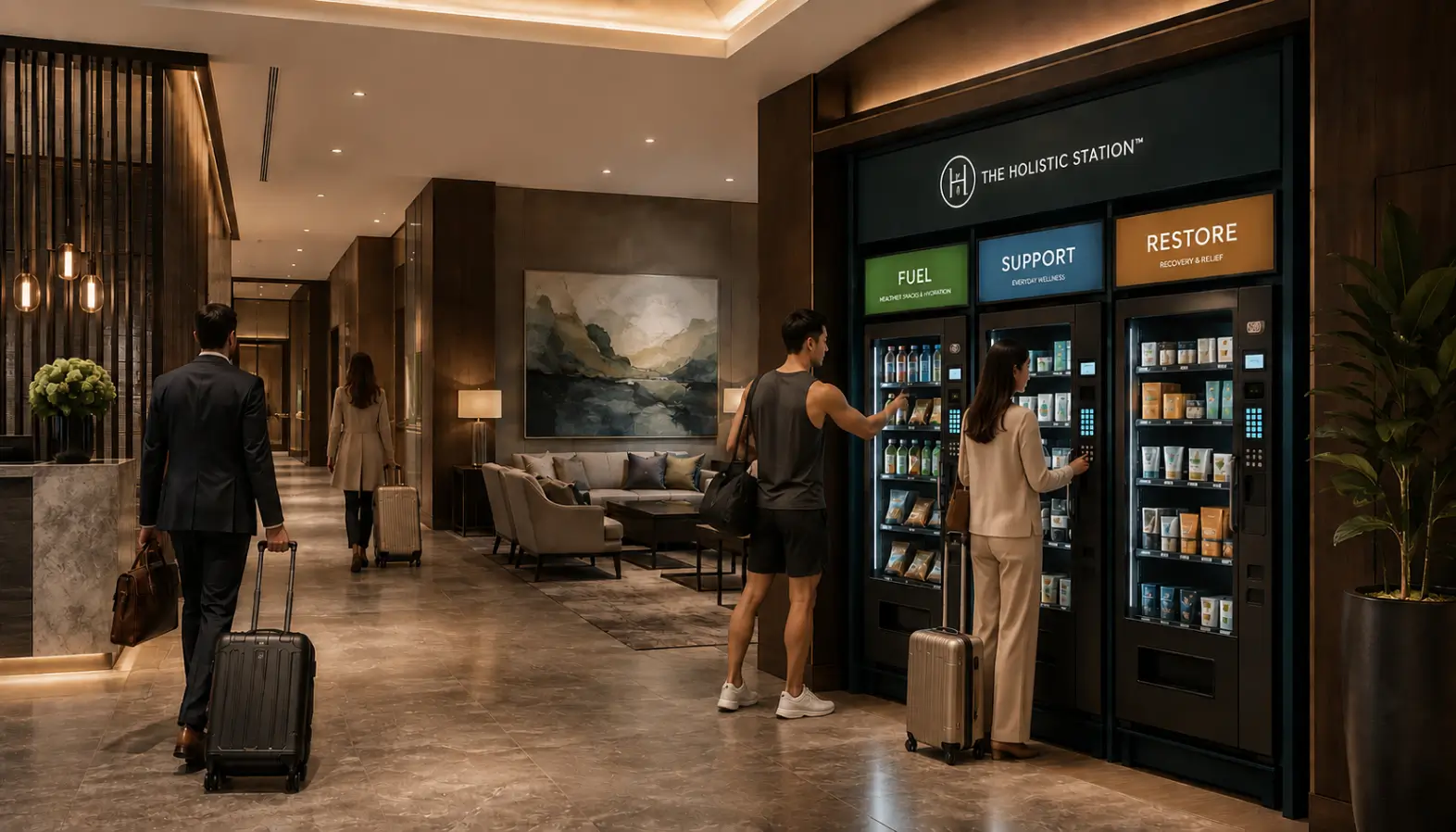
This is the space The Holistic Station™ is designed to address.
The Holistic Station™ is a managed wellness amenity for the places people live, work, stay and gather. Within hospitality, the objective is not simply to install vending machines or stock wellness products.
It is to create a thoughtfully curated, operationally managed extension of the guest experience.
The offering is organized around three practical areas:
FUEL provides healthier snacks and hydration.
SUPPORT provides everyday nonprescription wellness support.
RESTORE focuses on recovery-oriented products.
What belongs within each category should not be identical from property to property.
Guest profile, hotel type, location, length of stay, meetings and events business, existing amenities and the property’s overall positioning should help shape the assortment.
Then there is the less visible part of the experience: keeping the amenity stocked, reviewing what guests actually use, evaluating products, refreshing the assortment and maintaining clear boundaries around what is appropriate for the environment.
That operational layer matters.
Because a premium wellness amenity is only premium if the experience behind it is managed accordingly.
Wellness as an Extension of Service
The larger opportunity is not about asking hotels to become something they are not.
It is almost the opposite.
Hospitality has always been built around understanding what people need when they are away from home and finding thoughtful ways to provide it.
Wellness offers another dimension of that responsibility.
Sometimes that may mean a world-class spa.
Sometimes it is a fitness center, pool, recovery experience or wellness-focused menu.
And sometimes it may be as simple as a traveler finding the right hydration, healthier snack, everyday wellness support or recovery product exactly when they need it.
For hotels with extensive wellness offerings, that can extend an existing experience.
For hotels without them, it can create a way into the wellness conversation without the infrastructure of a traditional spa.
The opportunity is not wellness everywhere for the sake of wellness.
It is wellness where it makes sense.
Thoughtfully curated. Operationally sound. Aligned with the property and its guests.
Wellness within reach.
BRING WELLNESS WITHIN REACH™
The Holistic Station™ is a managed wellness amenity designed for the places people live, work, stay and gather.
Source Notes:
Global Wellness Institute, What Is Wellness Tourism? https://globalwellnessinstitute.org/what-is-wellness/what-is-wellness-tourism/
Hilton, 2026 Trends: Hushpitality / Seeking Sweet Silence. https://stories.hilton.com/2026-trends/hushpitality-seeking-sweet-silence
Westin Hotels & Resorts, Wellness. https://westin.marriott.com/wellness/
Hilton, 2026 Trends: Meetings and Events. https://stories.hilton.com/2026-trends-meetings-and-events