Organizations have invested heavily in employee wellness.
Health screenings. Fitness challenges. Meditation apps. Educational webinars. Employee assistance resources. Gym memberships. Coaching programs. Wellness portals.
Many of these programs provide real value.
But there is a persistent challenge between offering a wellness benefit and employees actually using it:
Participation
An employee may have access to an excellent wellness program and still have to register for it, download an app, remember another password, attend at a scheduled time, complete a challenge or carve out time during an already full workday.
Each additional step creates friction.
And in workplace wellness, friction matters.
Research conducted by RAND for the U.S. Department of Labor found that financial incentives were associated with higher participation in workplace wellness programs. But incentives were not the only factor. Program configuration also influenced participation, with employers offering comprehensive programs reporting higher participation rates and less sensitivity to the type of incentive being offered.
In RAND’s analysis, employers without incentives reported a median participation rate of 20 percent, compared with 40 percent among those using rewards and 73 percent among those using penalties or surcharges. Employers with comprehensive wellness programs reported the highest median participation rate at 59 percent.
RAND’s conclusion was particularly relevant: incentives can increase program uptake, but they are not a substitute for a well-designed program.
The question for employers may therefore be shifting.
It is no longer only:
What wellness programs do we offer?
It is also:
How easy is it for employees to actually engage with them?
The Distance Between Offering and Using
There is an important distinction between availability and utilization.
A resource can technically be available to every employee and still sit several steps away from the moment someone needs it.
Research into workplace wellness participation has identified practical barriers. In one employee survey reported by SHRM, nonparticipants cited lack of time, inconvenient program locations and insufficient knowledge about the program among their reasons for not participating. Among employees who did participate, convenience to work was the most commonly cited reason, reported by 70 percent of respondents.
A separate published study examining barriers to a workplace wellness program identified inconvenient locations and time limitations among the most frequently reported barriers to participation.
The lesson is straightforward:
A benefit can exist without being particularly easy to use.
Consider an ordinary workday.
An employee finishes a workout before work and realizes they forgot an electrolyte drink.
Someone develops a headache halfway through the afternoon.
Another employee feels a cold coming on and wants an everyday nonprescription wellness-support product.
Someone aggravates a muscle and wants a recovery product.
Another employee attended a short wellness education session two weeks ago, learned something useful and intended to act on it—but life moved on.
None of these moments necessarily calls for another wellness program.
They call for access.
And once access exists, they create something else that matters:
an opportunity for interaction.
What Social Media Understands About Engagement
There is an interesting lesson in the way digital platforms think about engagement.
A social media company would never consider a user highly engaged simply because the app was available on their phone.
Did they open it?
Did they interact?
Did they respond?
Did they return?
Workplace wellness is obviously not social media, nor should it attempt to replicate the attention mechanics of digital platforms.
But the underlying distinction is useful.
Availability is not engagement
An organization can offer an excellent wellness benefit that very few employees remember exists or regularly use.
For workplace wellness, the meaningful question is not simply whether an employee has access to a benefit. It is whether the environment makes interaction with wellness easy enough and relevant enough to happen naturally.
That changes the design challenge.
Instead of asking employees to continuously go somewhere else for wellness—to another platform, another appointment, another website or another scheduled activity—organizations can also look for ways to introduce relevant wellness interactions into places employees already move through during their day.
The objective is not to manufacture engagement.
It is to remove unnecessary friction from it.
Why Incentives Alone Are Not the Answer
Employers have been trying to solve the participation problem for years.
Rewards, insurance-premium incentives, gift cards, challenges and other participation incentives are common approaches. RAND’s broader workplace wellness research found employers using incentives ranging from cash and health-plan benefits to gift cards and novelty items.
And incentives can work.
The RAND research found higher median participation among employers using incentives than among employers offering none. But it also found that program configuration influenced participation and that comprehensive programs were less dependent on incentive structure.
That distinction matters.
An employer can continue increasing the reward for participating.
Or it can also examine the experience employees have to navigate before participation ever occurs.
How many steps are involved?
Does the employee have to remember the benefit exists?
Does participation happen at a particular time?
Does the employee have to leave the workplace?
Is the resource relevant when the employee actually encounters a need?
The participation research around time and location suggests that these practical considerations deserve attention.
Instead of continually asking:
How do we motivate employees to go to wellness?
There is another question worth asking:
How can wellness meet employees where they already are?
From Incentives to Wellness Reinforcement
This becomes particularly interesting when education, access and employer wellness benefits begin working together.
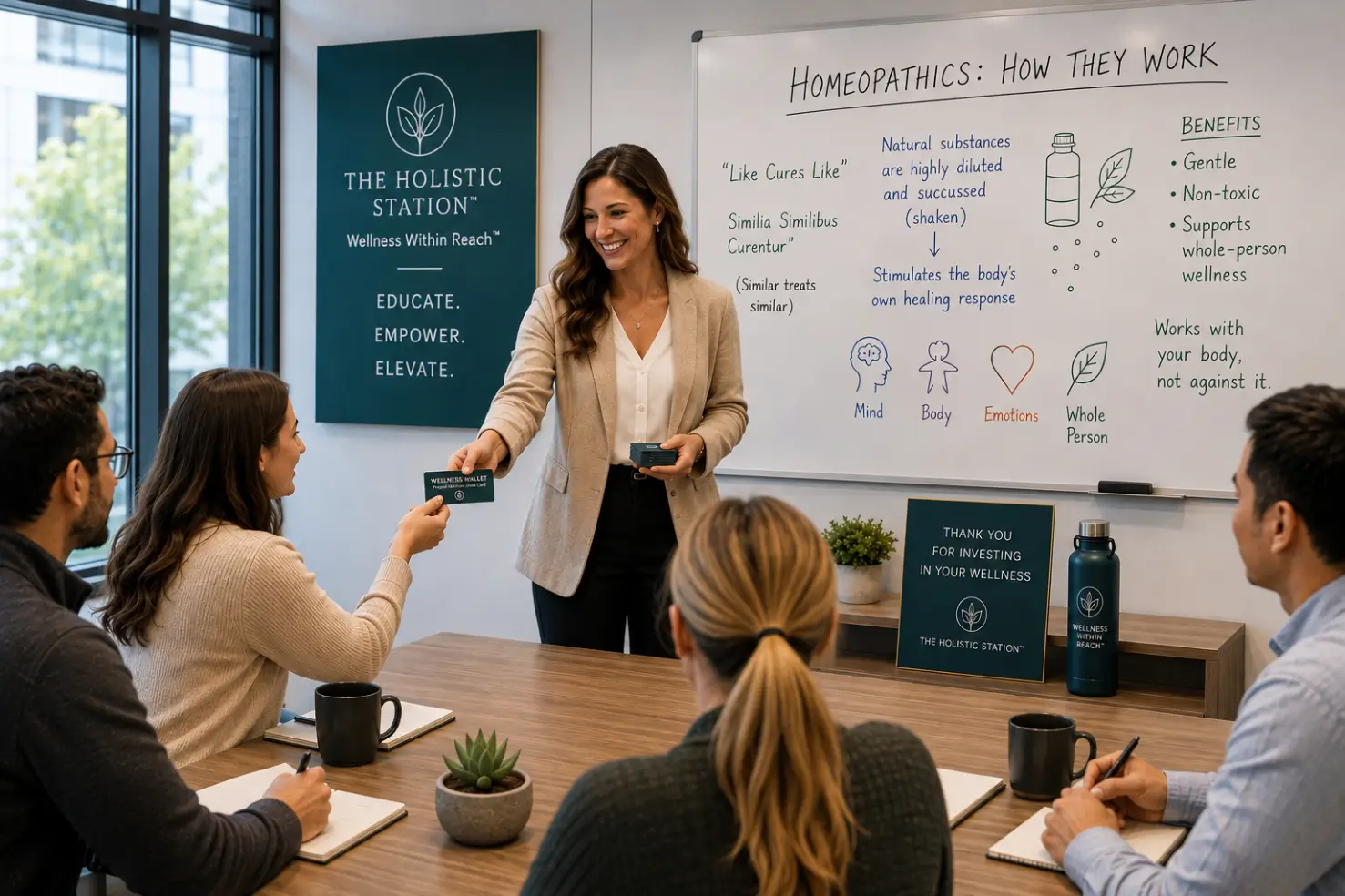
Imagine an employee attends a 15-minute microlearning session on hydration, sleep, recovery or everyday nutritional support.
Instead of the education ending when the session ends, participation could connect to a company-funded wellness benefit.
An employer might provide funds through a preloaded Wellness Wallet, for example, allowing an employee to apply that benefit toward an appropriate wellness product.
The sequence becomes:
Learn. Engage. Choose. Use. Return.
The incentive itself remains in alignment with wellness.
Rather than completing a wellness activity and receiving an unrelated promotional item, an employee receives something that can help make another wellness choice more accessible and reinforce healthier habits.
This creates an opportunity for physical and educational workplace wellness to reinforce one another.
Education creates awareness.
Access creates opportunity.
Employer support can reduce the financial barrier.
The next interaction reinforces the original education.
And wellness becomes something an employee can engage with during the normal course of the workday rather than only during a scheduled program.
From Participation to Interaction
This introduces another way of thinking about workplace wellness engagement.
Participation does not always have to mean completing a program.
It can also mean interacting with wellness in small, relevant ways.
An employee attends a microlearning session.
Another uses an employer-funded wellness benefit.
Someone chooses hydration after a workout.
Another employee selects a recovery-focused product after a physically demanding day.
Someone encounters an educational prompt and learns something they did not know.
Individually, these are small interactions.
Collectively, they can provide organizations with another lens through which to consider utilization.
Not simply:
Did we offer wellness?
But:
Are employees interacting with it?
That distinction becomes increasingly important when organizations evaluate the return on their wellness investment.
Utilization matters.
Small Wellness Moments Matter
Not every wellness interaction needs to be transformational.
Most people experience wellbeing through a series of small decisions.
What do I drink?
What snack do I choose between meetings?
What do I reach for when I don’t feel well?
How do I recover after a workout?
What do I do when my energy drops?
Do I remember what I learned last week when the moment arrives to actually use it?
A workplace environment can either make some of those choices easier or leave employees entirely on their own to navigate them.
That does not mean an employer should attempt to manage an employee’s health.
It means organizations can think more intentionally about the environment in which everyday choices occur, while empowering employees to take greater responsibility for their own wellbeing.
Convenience Without Curation Is Not Wellness
There is an important guardrail.
Simply placing more products in the workplace does not create a thoughtful wellness amenity.
Once wellness becomes physically accessible, curation matters even more.
Which products belong in the environment?
Which companies and products are reputable?
Where is third-party testing appropriate?
What products will employees realistically use?
What belongs in a workplace setting and what does not?
How should products be replenished, rotated and managed?
How does the offering remain in alignment with the organization and the people using it?
Wellness done well requires expertise and operational execution.
Accessibility without thoughtful curation can simply create more choice.
The objective should be relevant choice, supported by appropriate guardrails.
Turning Everyday Access Into a Managed Wellness Amenity
This is one of the ideas behind The Holistic Station™.
The Holistic Station™ is a managed wellness amenity designed to bring curated wellness access into the places people live, work, stay and gather.
Within a workplace environment, that can include:
FUEL — healthier snacks and hydration
SUPPORT — everyday nonprescription wellness support
RESTORE — recovery-focused products
But the larger opportunity is not simply putting products into vending machines.
It is connecting physical access with a broader wellness ecosystem.
Microlearning can introduce an idea.
A Wellness Wallet can give an employee resources to act on it.
The Holistic Station™ can make an appropriate product accessible when the employee actually needs it.
And each interaction creates another opportunity for the employee to engage with wellness.
The station becomes a point of engagement rather than simply a point of sale.
Complementing, Not Replacing, Workplace Wellness Programs
None of this eliminates the need for traditional workplace wellness.
A strong wellness strategy may still include health benefits, employee assistance programs, fitness resources, mental wellbeing support, education, coaching, screenings and other services.
Nor can an amenity compensate for larger workplace issues involving leadership, workload or organizational culture.
The opportunity is to complement those investments.
A webinar can educate.
A wellness platform can provide resources.
A coach can help someone make a meaningful change.
A fitness benefit can encourage movement.
Microlearning can keep relevant ideas visible.
And an accessible, well-curated wellness amenity can support employees during the ordinary moments between all of those things.
The future of workplace wellness may therefore be less about choosing between programs and amenities and more about connecting them.
Because a wellness resource has limited value when an employee never engages with it.
The strongest wellness ecosystems will not simply offer more.
They will reduce unnecessary friction between awareness and action.
They will make relevant resources easier to discover, easier to access and easier to use when they become relevant.
And they will create more opportunities for wellness to become part of the everyday employee experience.
That is the shift from access to engagement.
BRING WELLNESS WITHIN REACH™
The Holistic Station™ is a managed wellness amenity designed for the places people live, work, stay and gather.