For years, wellness in apartment communities has largely meant one thing: the fitness center.
Add a few treadmills, some weights, perhaps a pool or yoga room, and the wellness box was checked.
But the way we think about wellness is changing.
People are paying more attention to what they eat, how they sleep, how they manage stress, how they recover, and the small choices they make throughout the day. They are also increasingly looking at the environments around them and asking a simple question:
Does where I live make it easier or harder for me to take care of myself?
That creates an interesting opportunity for apartment communities.
The next generation of wellness amenities may not be about building a bigger fitness center or adding another massage room. It may be about making wellness more accessible in the everyday moments that happen outside of them.
What Are Wellness Amenities in an Apartment Community?
Wellness amenities are features, services and resources that make it easier for residents to support their well-being where they live.
A fitness center certainly qualifies. So do walking paths, pools, yoga rooms, saunas, meditation spaces, outdoor areas and increasingly popular recovery amenities.
But wellness is much broader than fitness.
It includes nutrition and hydration. Rest and recovery. Stress management. Sleep. Connection. Preventive wellness. And access to holistic products and resources that support the small choices people make every day.
That distinction matters.
Because while someone may use the fitness center three times a week, they make decisions that affect their well-being dozens of times every day.
What do I grab when I’m hungry?
Have I hydrated enough?
What can I do when I have a headache, an upset stomach, or can’t sleep?
How do I recover after a long day or when I’ve strained something at the gym?
Those moments are part of wellness, too.
And they are largely missing from the traditional apartment amenity conversation.
Wellness Is Moving Beyond the Fitness Center
Fitness centers aren’t going anywhere, nor should they.
Movement is foundational to well-being, and a quality fitness center can be a meaningful amenity for residents.
But wellness is evolving beyond exercise.
Across multifamily housing, we are seeing growing interest in recovery spaces, meditation rooms, saunas, cold plunges, outdoor environments, improved air quality, social connection and other amenities designed around a more holistic view of how people live.
This is a positive shift.
But it also raises another question:
What about the resident who doesn’t use the gym, sauna or yoga room?
Or the resident whose schedule doesn’t align with a class — or who simply wants convenient access to wellness products without making another trip to the store?
Wellness shouldn’t only be somewhere residents go.
It can become something they naturally encounter as part of everyday life.
That is where I believe the next opportunity lies.
The Accessibility Gap in Traditional Wellness Amenities
One of the biggest challenges with amenities is not simply offering them. It’s getting people to actually use them.
We all know the beautifully designed spaces that photograph wonderfully for the leasing brochure but sit relatively quiet much of the day.
That doesn’t mean they don’t have value.
It means there is another layer worth considering: accessibility.
The easier something is to use, the more likely it is to become part of someone’s routine.
That is true with almost every area of wellness.
Put the healthy choice three steps away instead of three miles away and you have changed the decision.
Make a recovery or wellness product conveniently available when someone needs it instead of requiring another trip to the store, and you have removed friction.
These may seem like small differences.
They aren’t.
Small, intentional choices repeated over time are often where meaningful change begins.
For apartment communities, this creates an opportunity to think differently about what a wellness amenity can be.
Five Ways Apartment Communities Can Make Wellness More Accessible
1. Make Better Nutrition and Hydration Convenient
We’ve all had the experience.
It’s late. You’re hungry. You don’t want to get back in the car or wait for a delivery, so you grab whatever is easiest.
Convenience usually wins.
Instead of fighting that reality, apartment communities can work with it.
Making thoughtfully selected snacks, functional beverages, hydration and better-for-you options conveniently available gives residents another choice when they need something quickly.
The goal isn’t perfection.
It’s simply making the better choice easier to reach.
2. Provide Access to Everyday Wellness Support
There is an enormous space between needing nothing and needing medical care.
It’s the everyday wellness space.
A resident realizes they’re out of an electrolyte supplement after a workout. Someone wants a simple sleep-support product before bed or feels a cold coming on. Another resident is looking for an everyday digestive, immune or nutritional support product.
Today, that usually means leaving the property or placing an online order.
Bringing carefully selected, nonprescription holistic wellness products into the residential environment creates another layer of convenience while supporting the broader wellness culture of the community.
It also reflects the way people increasingly think about their health: proactively rather than only reactively.
3. Think About Recovery, Not Just Exercise
We’ve become very good at encouraging people to move.
We’re getting better at remembering that bodies also need to recover.
Recovery is becoming an increasingly visible part of the wellness conversation, from stretching and mobility to red-light technology, massage and other self-care tools.
Not every community needs to build a dedicated recovery suite.
There are smaller-footprint ways to make recovery resources available and introduce residents to tools they might otherwise never experience.
That creates an important balance:
Move. Restore. Repeat.
4. Bring Wellness Into the Resident’s Natural Path
One of the simplest ways to make wellness more accessible is to stop asking residents to go somewhere specifically to find it.
Think about the spaces they already move through every day.
The lobby.
The resident lounge.
The fitness center entrance.
The mail or package area.
A shared common space.
These are natural touchpoints within the resident experience.
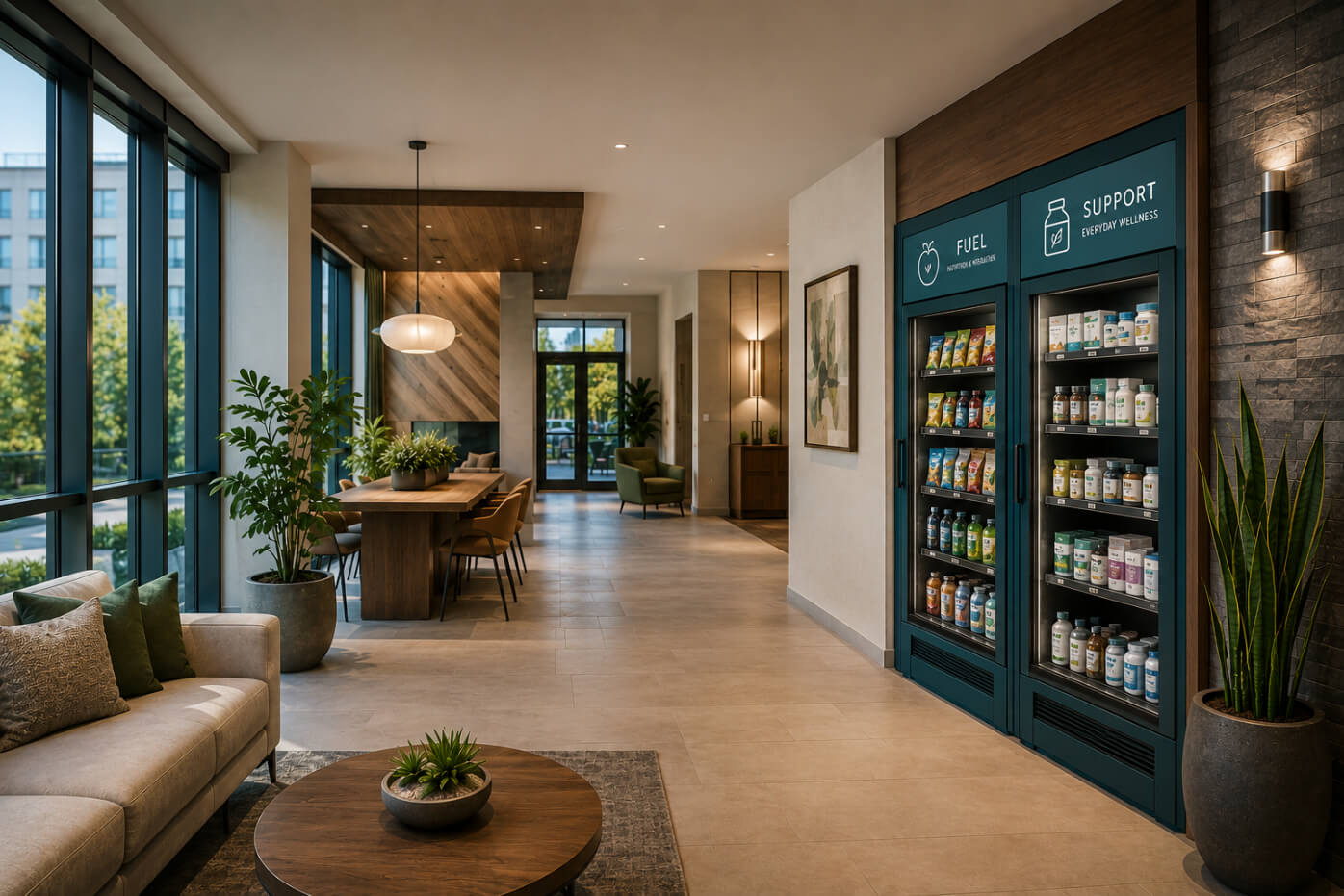
Placing wellness resources within that existing path removes another layer of friction. There is no special trip, appointment or schedule to coordinate.
Wellness simply becomes part of the environment.
5. Design Wellness Around Real Schedules
Wellness shouldn’t close at 5:00.
People work different schedules. Parents have children. Professionals travel. Some residents are early risers and others come alive at night.
Self-service wellness gives residents the freedom to engage when it works for them.
No appointment.
No class schedule.
No additional staff member required.
Just access.
And access is one of the most underestimated guardrails for healthier behavior.
Wellness Without Another Major Buildout
There is another practical consideration for property owners and managers: space.
Real estate is expensive.
Every square foot dedicated to an amenity needs to earn its place within the resident experience and the larger property strategy.
Many of the wellness amenities receiving attention today are impressive. Saunas, cold plunges, recovery rooms, red light therapy, yoga studios and spa environments can create tremendous value in the right property.
But they also require space, capital investment, maintenance and, in some cases, specialized infrastructure.
Not every property has that flexibility.
And it shouldn’t mean those communities are excluded from the wellness conversation.
There is another approach.
Instead of asking, “What wellness room should we build next?” we can also ask:
“How can we bring more wellness into the spaces we already have?”
A lobby.
A resident lounge.
A fitness center entrance.
A mail or package area.
A common space residents already pass through every day.
The opportunity is to bring wellness into the resident’s natural path rather than always asking the resident to go somewhere specifically to find it.
A Different Approach to the Wellness Amenity
This thinking is part of what led us to create The Holistic Station™.
We saw a gap between traditional vending and traditional wellness amenities.
On one side, convenience was readily available, but the choices weren’t wellness-aligned with how people increasingly want to live.
On the other side were wellness programs, fitness facilities and beautiful dedicated spaces that required time, participation or significant investment.
There was room in between.
The Holistic Station™ was designed around a simple idea:
What if everyday wellness was simply easier to access?
Our managed wellness ecosystem brings together three areas of daily well-being:
FUEL focuses on thoughtfully selected snacks, nutrition and hydration.
SUPPORT provides convenient access to supportive health items and nonprescription holistic wellness products for everyday needs.
RESTORE introduces recovery and self-care products that support the other side of performance: slowing down, resetting and restoring.
The intention isn’t to replace the fitness center, the pool, the yoga class or any of the wellness amenities residents already value.
It’s to fill the spaces between them.
To make wellness available on an ordinary Tuesday evening when someone is standing in the lobby thinking, “I need something.”
That’s where convenience and well-being can come into alignment.
What Should Property Managers Consider When Adding Wellness Amenities?
Before adding another amenity, it is worth asking a few practical questions.
Will this serve a broad range of residents, or primarily those already engaged in wellness?
How easily can residents access it?
Does it require additional staffing?
Does the design and experience align with the quality and aesthetic standards of our property and brand?
How much physical space does it require?
What maintenance will it add for the property team?
Can the offering change as resident interests and wellness trends evolve?
Does it complement the amenities we already have?
And perhaps most importantly:
Will residents actually use it?
The best wellness amenity isn’t necessarily the biggest, newest or most expensive.
It is the one that becomes part of people’s lives.
The Future of Apartment Wellness Is Everyday Wellness
We don’t need to turn apartment communities into wellness resorts.
We do have an opportunity to rethink the environments where people spend so much of their lives.
A healthier community can be created through large investments, but it can also be shaped through small, intentional decisions.
Better choices.
Less friction.
More opportunities to nourish, support and restore.
The future of apartment wellness may not be defined by who builds the largest fitness center or the most elaborate spa.
It may be defined by something much simpler:
How easy did we make it for someone to choose well today?
That is where wellness moves beyond being an amenity.
It becomes part of the environment.
And that is how we bring Wellness Within Reach™.
Bring Wellness Within Reach™
The Holistic Station™ is a managed wellness amenity designed for the places people live, work, stay and gather.
Explore how The Holistic Station™ can add accessible, everyday wellness to your apartment community without another major buildout.